The Indian judiciary has long been regarded as one of the most respected career paths for law graduates seeking public service, intellectual challenge, and social impact. In recent days, Chief Justice of India-designate Justice Surya Kant drew nationwide attention after sharing a deeply personal career lesson while hearing a plea related to judicial services examination paper re-evaluation. His remarks quickly resonated with law students, judiciary aspirants, and young advocates across the country.
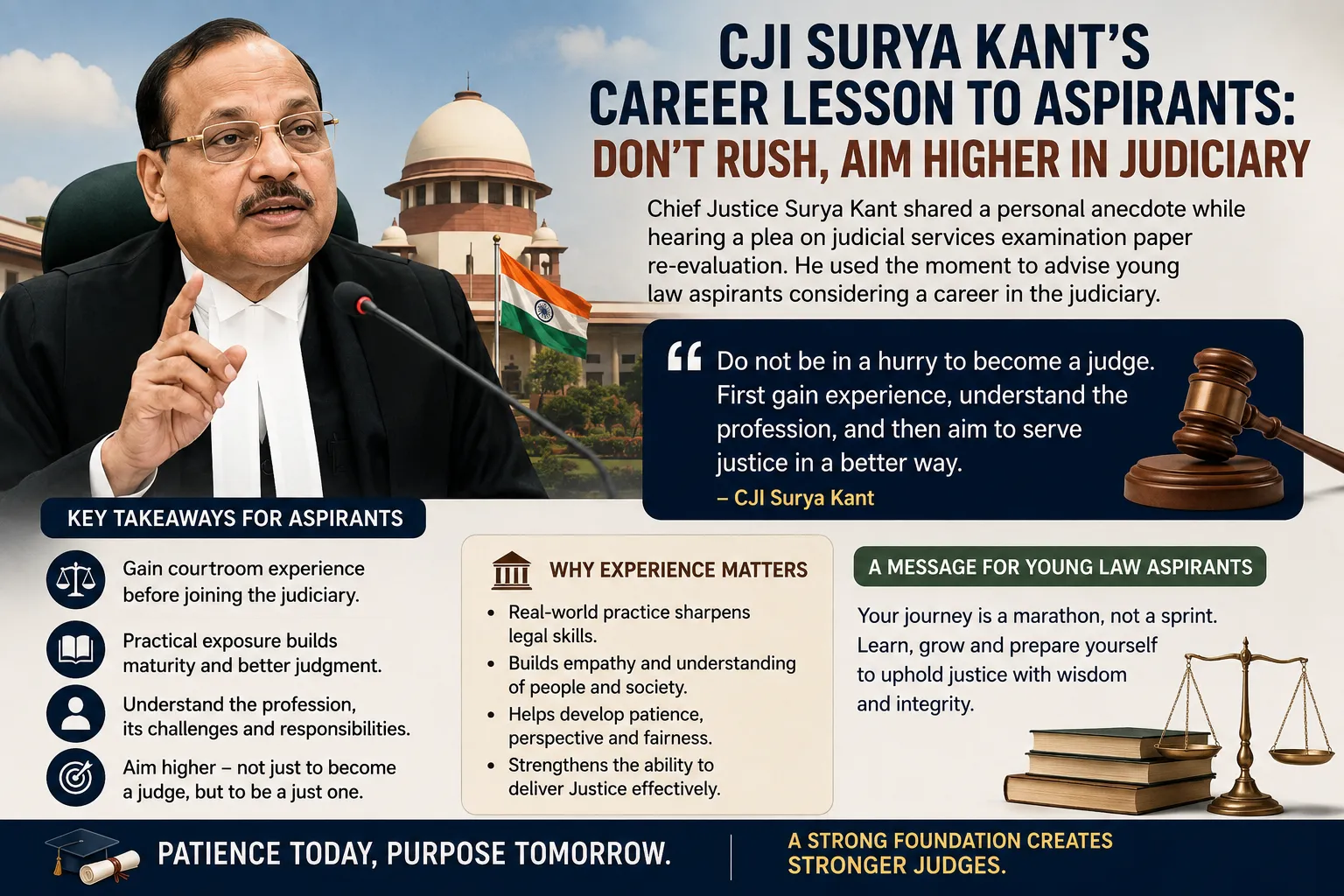
During the hearing, Justice Surya Kant reflected on his own legal journey and advised aspiring lawyers not to rush prematurely into judicial service solely for job security or immediate career stability. Instead, he encouraged young legal professionals to first gain wider exposure, practical courtroom experience, and professional maturity before entering the judiciary.
His comments have sparked broader discussions about the ideal path toward becoming a judge in India. Many legal experts believe the statement highlights important concerns about professional readiness, judicial quality, and the evolving expectations from India’s justice system.
At a time when lakhs of law graduates prepare for competitive judicial examinations every year, Justice Surya Kant’s message has become a significant reminder that patience, experience, and long-term growth often matter more than early career shortcuts.
Justice Surya Kant’s Remarks During Court Proceedings
Justice Surya Kant made the observations while hearing a matter connected to the re-evaluation of judicial services examination papers. During the proceedings, he referred to his own professional journey and spoke candidly about career decisions within the legal field.
The judge emphasised that young law graduates should not become overly desperate to enter the judiciary immediately after completing their studies. According to his remarks, aspiring judges should first spend meaningful time practising law, understanding courtroom dynamics, and developing legal maturity.
He reportedly noted that practical exposure helps lawyers build confidence, legal reasoning, and broader understanding of society — qualities that become critically important when later serving as judges.
The comments were not intended to discourage judicial careers. Instead, they reflected a belief that the judiciary benefits when judges enter the system with stronger real-world legal experience and professional perspective.
His observations immediately attracted attention because they touched upon an issue widely debated within India’s legal community for many years.
Why Judicial Services Attract So Many Aspirants
Judicial services examinations remain among the most prestigious career opportunities for law graduates in India. Every year, thousands of students prepare intensely for state-level judicial exams that recruit civil judges and magistrates.
Several factors contribute to the growing popularity of judicial careers:
Job Stability and Respect
The judiciary offers stable government service, professional respect, and long-term career security. Many students view the profession as a dignified public service role with significant social influence.
Rising Competition in Litigation
The legal profession has become increasingly competitive, especially for young advocates starting independent practice. Many graduates find judicial service financially safer than uncertain early litigation careers.
Faster Career Structure
Judicial service provides structured promotions, regular income, and institutional career progression, which can appear more predictable than private legal practice.
Public Service Motivation
Some aspirants are genuinely motivated by a desire to uphold justice, constitutional values, and legal fairness within society.
However, Justice Surya Kant’s remarks suggest that while these motivations are understandable, immediate entry into the judiciary may not always produce the strongest long-term judges.
The Importance of Courtroom Experience Before Becoming a Judge
One of the central ideas behind Justice Surya Kant’s advice is the value of practical courtroom experience. Many senior legal professionals believe judges perform better when they have firsthand understanding of litigation realities.
Understanding Human Behaviour
Law is not limited to textbooks and legal theory. Courtroom practice exposes lawyers to human conflict, emotional complexity, social inequality, and real-world consequences of legal decisions.
Developing Advocacy Skills
Years spent practising law help advocates improve legal interpretation, argument construction, negotiation, and procedural understanding. These skills strengthen judicial reasoning later in a judge’s career.
Exposure to Different Areas of Law
Young advocates who practise before entering the judiciary often gain broader exposure to criminal law, civil disputes, constitutional matters, family law, and commercial litigation.
Building Professional Maturity
Courtroom experience teaches patience, discipline, ethical responsibility, and decision-making under pressure. Many experts believe these qualities are difficult to fully develop through examination preparation alone.
Justice Surya Kant’s comments reflect the belief that judicial authority becomes stronger when combined with professional maturity developed through years of practical legal engagement.
Debate Over Early Judicial Entry in India
India’s judicial recruitment system has long faced debate regarding whether fresh law graduates should directly enter the judiciary without substantial practice experience.
Some states previously required minimum years of legal practice before candidates became eligible for judicial services exams. However, many recruitment systems now allow fresh graduates to compete shortly after completing law school.
Supporters of direct recruitment argue that:
-
Younger judges adapt faster to legal reforms
-
Fresh graduates often possess strong academic knowledge
-
Early recruitment reduces career uncertainty
-
Judicial vacancies can be filled more efficiently
However, critics believe very young judges may initially lack the professional depth required for handling complex legal and human issues.
Justice Surya Kant’s remarks appear to align more closely with the view that broader legal exposure strengthens judicial capability.
The debate continues because both academic excellence and practical experience play important roles in shaping effective judges.
India’s Judiciary Requires High Standards of Excellence
The Indian judiciary carries enormous responsibility because judges regularly decide matters involving liberty, property, constitutional rights, public policy, and criminal justice.
As court cases become increasingly complex, many legal experts believe judicial officers require:
Deep Legal Understanding
Judges must interpret complicated laws, constitutional principles, and evolving legal precedents with precision and fairness.
Social Sensitivity
Modern courts increasingly deal with issues involving gender rights, technology, privacy, economic regulation, environmental protection, and social justice.
Emotional Balance
Judges frequently handle emotionally sensitive cases involving family disputes, criminal accusations, and life-changing consequences.
Ethical Integrity
Public trust in the judiciary depends heavily on the professionalism, independence, and integrity of judicial officers.
Justice Surya Kant’s advice reflects concern that judicial preparation should focus not only on passing exams but also on developing the broader qualities required for responsible adjudication.
Judicial Aspirants Face Intense Pressure
The conversation surrounding judicial careers also highlights the enormous pressure faced by law graduates today. Competitive examinations in India have become highly demanding, with aspirants often spending years preparing for limited vacancies.
Many students feel pressure from:
-
Financial insecurity
-
Family expectations
-
Competitive career markets
-
Social comparison
-
Delayed professional stability
As a result, judicial service is often viewed as one of the safest legal career paths.
However, senior legal professionals frequently advise young lawyers not to measure success only through immediate government employment. Many respected judges, senior advocates, and legal scholars built distinguished careers after years of litigation practice.
Justice Surya Kant’s remarks may therefore serve as reassurance that slower professional growth does not necessarily mean failure.
The Value of Patience in Legal Careers
One of the strongest themes emerging from Justice Surya Kant’s observations is patience. Legal careers often develop gradually, requiring years of learning, observation, and professional evolution.
Litigation Teaches Resilience
Young advocates frequently face difficult beginnings involving low earnings, long hours, and uncertain opportunities. However, litigation experience often develops strong legal instincts over time.
Experience Improves Decision-Making
Professional maturity usually grows through exposure to real legal conflicts rather than examination preparation alone.
Career Growth Is Not Always Linear
Many successful legal professionals initially struggled before later achieving recognition, senior positions, or judicial appointments.
Justice Surya Kant’s comments encourage aspirants to view legal careers as long-term journeys rather than immediate races for secure positions.
Legal Education and the Future of Judiciary
The remarks have also renewed discussions about reforms in legal education and judicial preparation in India. Experts increasingly believe future judicial systems must combine academic excellence with practical legal understanding.
Several reforms are often suggested:
Better Internship Opportunities
Law students need stronger exposure to courtroom functioning, legal drafting, and litigation processes during their education.
Mentorship Systems
Senior advocates and retired judges can help guide young lawyers through professional challenges and ethical development.
Judicial Training Expansion
Continuous training programs for judicial officers may improve decision-making, technological adaptation, and legal specialisation.
Encouraging Broader Legal Experience
Some experts continue advocating for minimum litigation experience before judicial appointments at lower levels.
The broader objective remains strengthening judicial quality while maintaining fair access to judicial careers.
Final Thoughts
Chief Justice-designate Justice Surya Kant’s career advice has resonated widely because it addresses a challenge faced by countless young law graduates across India — the pressure to secure immediate career stability in an increasingly competitive legal environment.
By encouraging aspirants not to rush into judicial service too early, he highlighted the importance of experience, patience, and professional maturity in shaping effective judges. His remarks reflect a broader belief that strong judicial systems depend not only on examination success but also on practical legal understanding and human insight.
At a time when India’s judiciary continues handling increasingly complex legal and constitutional questions, the conversation surrounding judicial preparation has become more important than ever.
For young lawyers, Justice Surya Kant’s message serves as a reminder that legal careers are built over time through learning, persistence, and experience. The journey toward the judiciary may be longer for some, but deeper professional exposure can ultimately create stronger judges, wiser decision-makers, and a more effective justice system for the country.
newstapy.com newstapy.com newstapy.com newstapy.com newstapy.com newstapy.com newstapy.com newstapy.com newstapy.com newstapy.com newstapy.com newstapy.com newstapy.com newstapy.com newstapy.com newstapy.com newstapy.com newstapy.com newstapy.com newstapy.com newstapy.com newstapy.com newstapy.com newstapy.com newstapy.com newstapy.com newstapy.com newstapy.com newstapy.com newstapy.com newstapy.com newstapy.com newstapy.com newstapy.com newstapy.com newstapy.com newstapy.com newstapy.com newstapy.com newstapy.com newstapy.com newstapy.com newstapy.com newstapy.com newstapy.com newstapy.com newstapy.com newstapy.com newstapy.com newstapy.com newstapy.com newstapy.com newstapy.com newstapy.com newstapy.com newstapy.com newstapy.com newstapy.com newstapy.com newstapy.com newstapy.com newstapy.com newstapy.com newstapy.com newstapy.com newstapy.com newstapy.com newstapy.com newstapy.com newstapy.com newstapy.com newstapy.com newstapy.com newstapy.com newstapy.com newstapy.com newstapy.com newstapy.com newstapy.com newstapy.com newstapy.com newstapy.com newstapy.com newstapy.com newstapy.com newstapy.com newstapy.com newstapy.com newstapy.com newstapy.com newstapy.com newstapy.com newstapy.com newstapy.com newstapy.com newstapy.com newstapy.com newstapy.com newstapy.com newstapy.com newstapy.com newstapy.com newstapy.com newstapy.com newstapy.com newstapy.com newstapy.com newstapy.com newstapy.com newstapy.com newstapy.com newstapy.com newstapy.com newstapy.com newstapy.com newstapy.com newstapy.com newstapy.com newstapy.com newstapy.com newstapy.com newstapy.com newstapy.com newstapy.com newstapy.com newstapy.com newstapy.com newstapy.com newstapy.com newstapy.com newstapy.com newstapy.com newstapy.com newstapy.com newstapy.com newstapy.com newstapy.com newstapy.com newstapy.com newstapy.com newstapy.com newstapy.com newstapy.com newstapy.com newstapy.com newstapy.com newstapy.com newstapy.com newstapy.com newstapy.com newstapy.com newstapy.com newstapy.com newstapy.com newstapy.com newstapy.com newstapy.com newstapy.com newstapy.com newstapy.com newstapy.com newstapy.com newstapy.com newstapy.com newstapy.com newstapy.com newstapy.com
