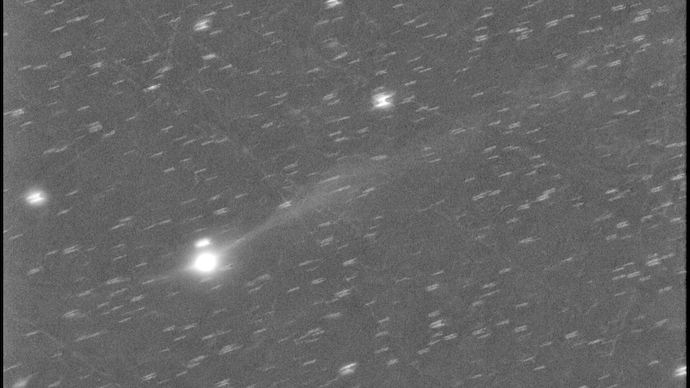
Astronomers around the world are excited after spotting a mysterious object — Comet 3I/Atlas, an interstellar comet that is traveling through our Solar System. The comet was recently captured by the Virtual Telescope Project, showing a bright core and a glowing, well-defined ion tail stretching across space. This rare sight has once again sparked curiosity about objects that come from beyond our Solar System.
A Visitor From Deep Space
Comet 3I/Atlas is not an ordinary comet. The “3I” in its name means it’s the third known interstellar object detected so far — meaning it didn’t originate in our Solar System. Instead, it is believed to have come from a completely different star system, traveling across space for millions of years before entering our cosmic neighborhood.
The first such object was ‘Oumuamua, spotted in 2017, and the second was Comet Borisov in 2019. Now, 3I/Atlas joins this very small list of interstellar visitors — and scientists are eager to learn more about its composition, origin, and trajectory.
What the Image Reveals
The Virtual Telescope Project, led by astronomer Gianluca Masi in Italy, managed to capture a detailed image of the comet as it passed through space. The photo shows a bright coma — the glowing cloud of gas and dust surrounding the comet’s nucleus — and a long, bluish ion tail extending outward.
This ion tail is formed as the comet approaches the Sun, causing solar radiation to heat its icy surface. The resulting gases and charged particles are blown away by the solar wind, creating a tail that always points away from the Sun. In 3I/Atlas’s case, the tail’s clarity and brightness make it easier for astronomers to study its structure.
veroniquelacoste.com | funtacoslv.com | yesnohelp.com
mopandpail.com | spiderdevelopers.co.in
Why It’s So Special
Interstellar comets like 3I/Atlas are extremely rare. Most comets in our Solar System orbit the Sun in long, predictable paths, often coming from regions like the Kuiper Belt or the Oort Cloud. But interstellar comets travel on hyperbolic trajectories — meaning they are just passing through and will eventually leave our Solar System forever.
Scientists believe 3I/Atlas was ejected from another star system long ago, possibly during the early stages of planet formation. As planets and stars form, strong gravitational forces can fling smaller icy bodies like comets into interstellar space. These wandering objects can then drift for billions of kilometers before being pulled temporarily by another star — in this case, our Sun.
Tracking Its Journey
Early observations show that 3I/Atlas entered the Solar System from the direction of the constellation Lynx. It is expected to pass through the inner Solar System over the next few months before heading back out into deep space.
Astronomers have been using ground-based telescopes and space observatories to track its brightness, movement, and chemical composition. Because of its interstellar origin, 3I/Atlas gives researchers a rare opportunity to study materials that were formed around another star, offering clues about how other planetary systems develop.
What We’ve Learned So Far
Preliminary spectroscopic data — which analyze the light emitted by the comet — suggest that 3I/Atlas contains carbon-rich compounds and frozen gases similar to those found in comets within our Solar System. This indicates that even though it comes from another star system, the process of comet formation might be quite similar across the universe.
However, some features also make it unique. The ratio of certain elements, such as carbon and nitrogen, appears slightly different from typical Solar System comets. This difference might hint at the environment in which the comet was formed — perhaps around a cooler or smaller star than our Sun.
Can We See It From Earth?
Right now, Comet 3I/Atlas is not visible to the naked eye, but amateur astronomers with mid-sized telescopes might be able to spot it in dark skies over the coming weeks. Its brightness could fluctuate as it approaches the Sun and then fades again as it moves away.
The Virtual Telescope Project and other observatories are planning to livestream its movement, allowing sky-watchers around the world to see this once-in-a-lifetime event online.
Why Interstellar Visitors Matter
The arrival of interstellar objects like 3I/Atlas is scientifically important. These objects are like natural messengers from distant star systems, carrying with them information about the materials, temperatures, and conditions that exist far beyond our reach.
By studying their composition and motion, astronomers can compare them with Solar System objects and test theories about how planets and comets form. They also help us understand how common certain molecules — including those that might lead to life — are throughout the universe.
Moreover, interstellar comets give us a glimpse of how material can travel between stars, suggesting that the building blocks of life might move from one planetary system to another through such cosmic wanderers.
The Challenges of Studying It
Tracking interstellar objects is not easy. They move at incredible speeds, often exceeding 100,000 kilometers per hour, and are only visible for a short time before leaving the Solar System again. Their faint light also makes detailed observations difficult without powerful telescopes.
NASA and other space agencies have been discussing possible missions to study such interstellar visitors up close in the future. A spacecraft mission to intercept and analyze a passing interstellar comet could revolutionize our understanding of the cosmos.
Looking Ahead
As Comet 3I/Atlas continues its journey, astronomers worldwide will keep a close watch. The data gathered over the next few months will be used to model its orbit and study its chemical fingerprints in greater detail. Every discovery adds to our growing understanding of how diverse and dynamic our universe really is.
For now, 3I/Atlas serves as a beautiful reminder that our Solar System is not isolated. It is part of a vast, interconnected galaxy filled with countless mysteries — and sometimes, those mysteries come visiting.